Dr. Bandung Sahari Shared His Experience on Pesticide Application and Pest Management in Oil Palm Plantations
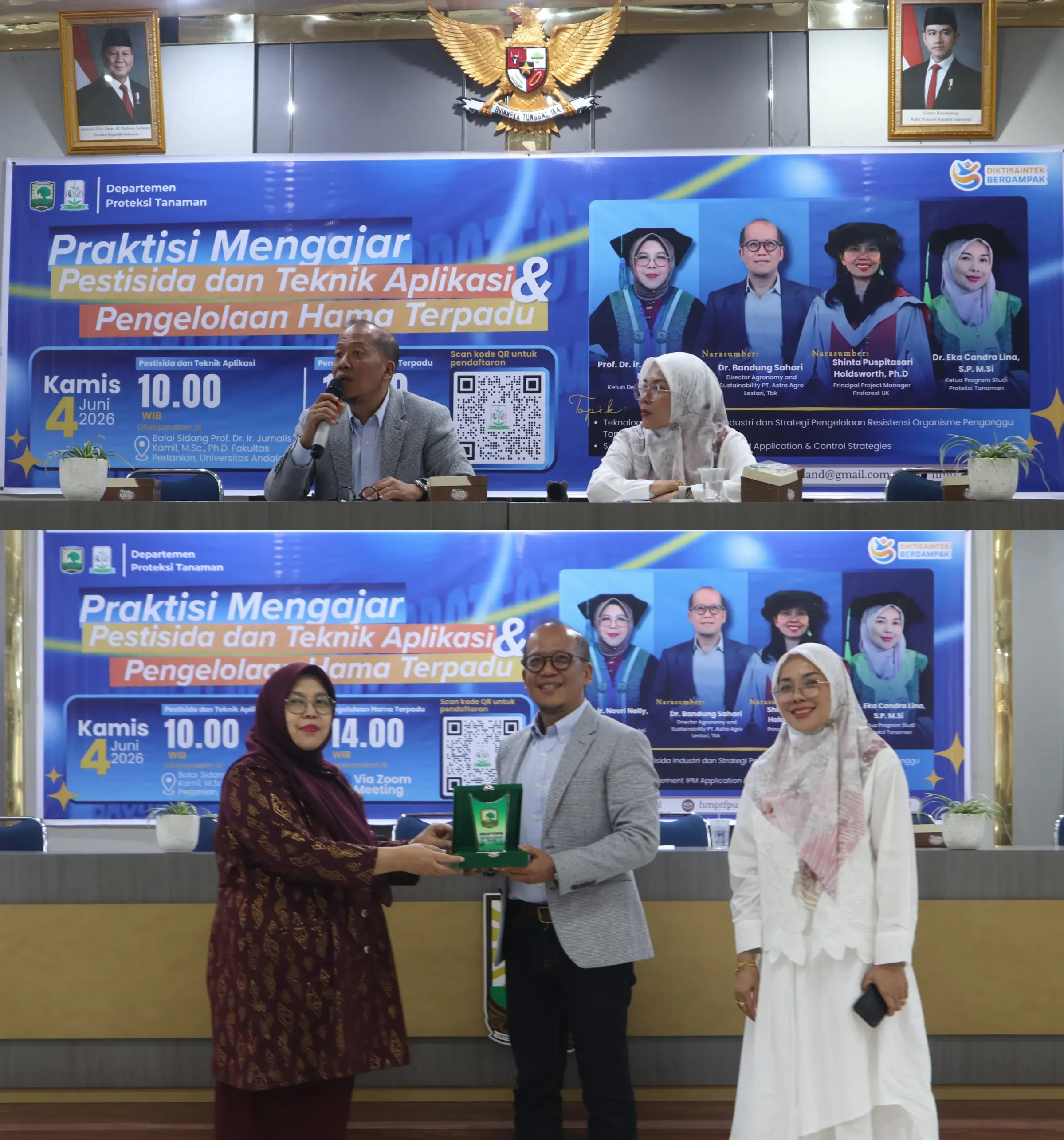
Padang, June 4, 2026 — The Department of Plant Protection, Faculty of Agriculture, Universitas Andalas, in collaboration with the Plant Protection Student Association, organized a Practitioners Teaching activity for the course Pesticides and Application Techniques. The event featured Dr. Bandung Sahari, Director of Agronomy and Sustainability at PT Astra Agro Lestari Tbk, as the main speaker with the topic “Pesticide Application Technology in Oil Palm Plantations and Its Management Strategies.”
In his presentation, Dr. Bandung Sahari explained that the management of plant pests and diseases in oil palm plantations requires a precise, measurable, and sustainable approach. He emphasized that successful control is not only determined by the type of pesticide used, but also by the accuracy of application technology, an understanding of the bioecology of target organisms, and the implementation of management strategies that are appropriate to field conditions.
The discussion then focused on the control of the rhinoceros beetle (Oryctes rhinoceros), an important pest of oil palm, particularly in young plantations and replanting areas, as well as the management of basal stem rot caused by Ganoderma, which remains one of the major challenges in oil palm cultivation. Drawing on his practical experience in the plantation industry, Dr. Bandung Sahari highlighted the importance of early detection, sanitation, management of infected plants, and the application of technologies and cultivation practices that support overall plant health.
Another topic that attracted participants’ attention was the role of the pollinating weevil Elaeidobius. Dr. Bandung Sahari explained that Elaeidobius is an oil palm pollinating insect that was initially introduced from Malaysia. At present, this pollinating weevil has been able to survive, adapt, and spread widely across oil palm plantation areas in Indonesia, from Aceh to Papua. The presence of Elaeidobius is highly essential because it plays an important role in supporting the pollination of oil palm flowers, which ultimately contributes to successful fruit formation and crop productivity.
This Practitioners Teaching activity provided valuable learning experiences for students by bringing direct insights from an industry practitioner. Students not only gained theoretical understanding of pesticides and their application techniques, but also obtained a real-world perspective on the challenges of pest and disease management in large-scale oil palm plantations.
Through this activity, the Department of Plant Protection, Faculty of Agriculture, Universitas Andalas, continues to strengthen the connection between university-based learning and professional field practices.