Endophytic Bacteria: An Eco-Friendly Innovation to Protect Rice from Brown Planthopper
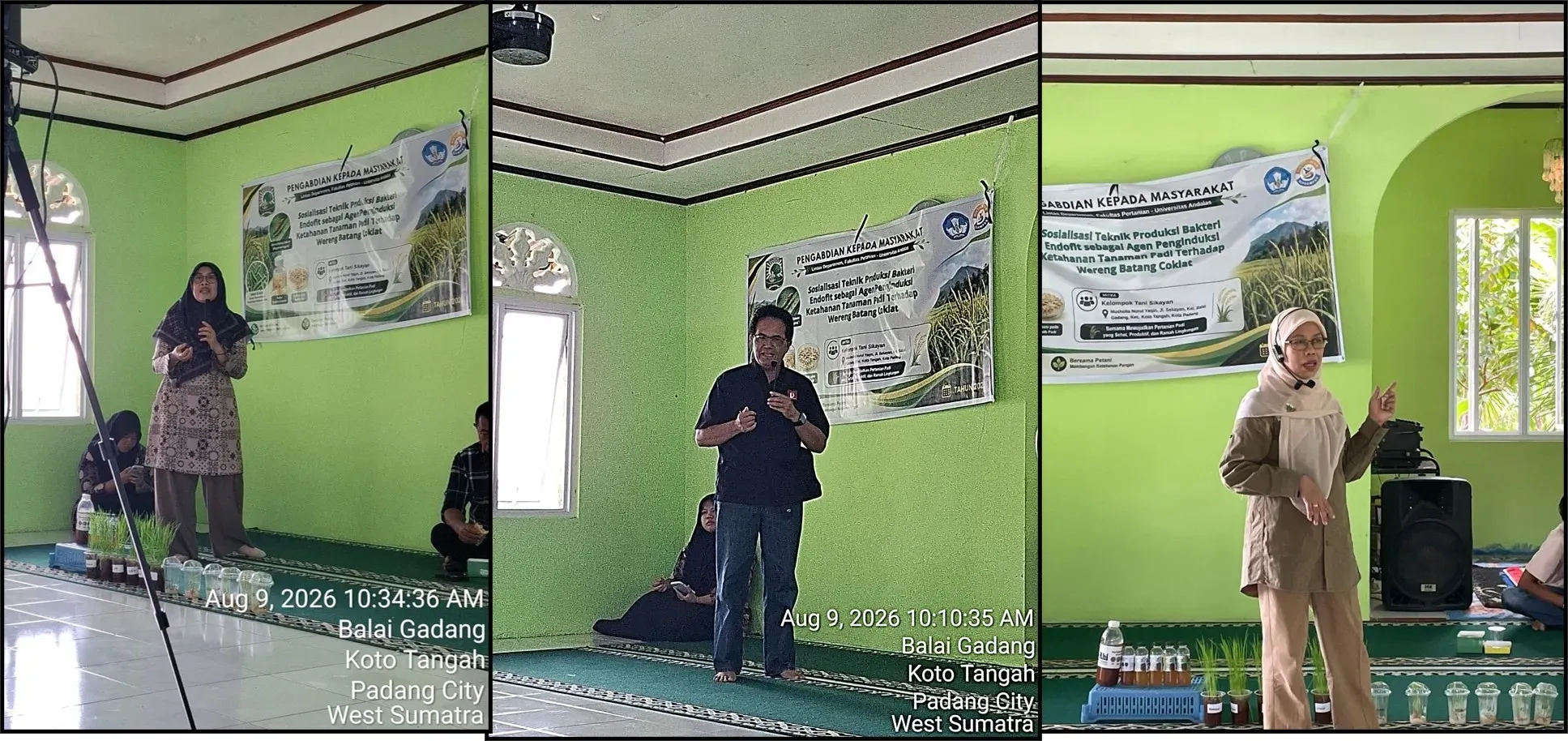
Padang, 9 August 2026 — An interdisciplinary Community Service Team from the Faculty of Agriculture, Universitas Andalas, coordinated by Dr. Haliatur Rahma from the Department of Plant Protection, conducted an outreach activity on the use of endophytic bacteria as agents for inducing rice resistance to the brown planthopper. The activity was conducted in collaboration with the Sikayan Farmer Group in Balai Gadang, Koto Tangah District, Padang City.
The community service program is planned to be conducted through a series of meetings. The first meeting featured three resource persons: Prof. Hermansah, Dr. Haliatur Rahma, and Dr. My Syahrawati.
The brown planthopper is one of the most important insect pests of rice and can cause severe damage when its population increases. Excessive reliance on insecticides for its control can not only increase production costs but also disrupt the ecological balance of rice agroecosystems. Therefore, the use of endophytic bacteria offers a promising approach to support more environmentally friendly and sustainable pest management.
Dr. Haliatur Rahma, as the main speaker at the event, introduced farmers to an alternative technology for brown planthopper management through the use of beneficial microorganisms, particularly endophytic bacteria. She explained the characteristics of endophytic bacteria and their potential to enhance plant resistance. Endophytic bacteria are microorganisms that can live within plant tissues without causing disease symptoms. Their presence can provide various benefits to plants, including promoting plant growth and inducing defense mechanisms against pests and other harmful organisms.
In addition to the presentation, the activity included a demonstration comparing rice plants treated with endophytic bacteria with untreated plants. Rice plants treated with endophytic bacteria showed better growth, whereas untreated plants exhibited hopperburn symptoms caused by brown planthopper infestation. This demonstration provided farmers with a direct illustration of the potential of endophytic bacteria to enhance plant resistance and is expected to encourage their participation in applying the technology under field conditions.
The use of endophytic bacteria is expected not only to provide an alternative approach for increasing rice resistance to the brown planthopper but also to contribute to long-term efforts to reduce dependence on pesticides and promote sustainable agriculture in Padang City and West Sumatra.
Through this community service program, the Faculty of Agriculture, Universitas Andalas, continues to strengthen the transfer of knowledge and technology from universities to local communities, while promoting effective, practical, and environmentally friendly innovations in plant protection. The program is funded by the 2026 Faculty of Agriculture Community Service Grant, Universitas Andalas, under Contract No. 45/SPK/PLK/RKAT Faperta Unand/2026.