UNAND and HUAF Share experiences on biological control
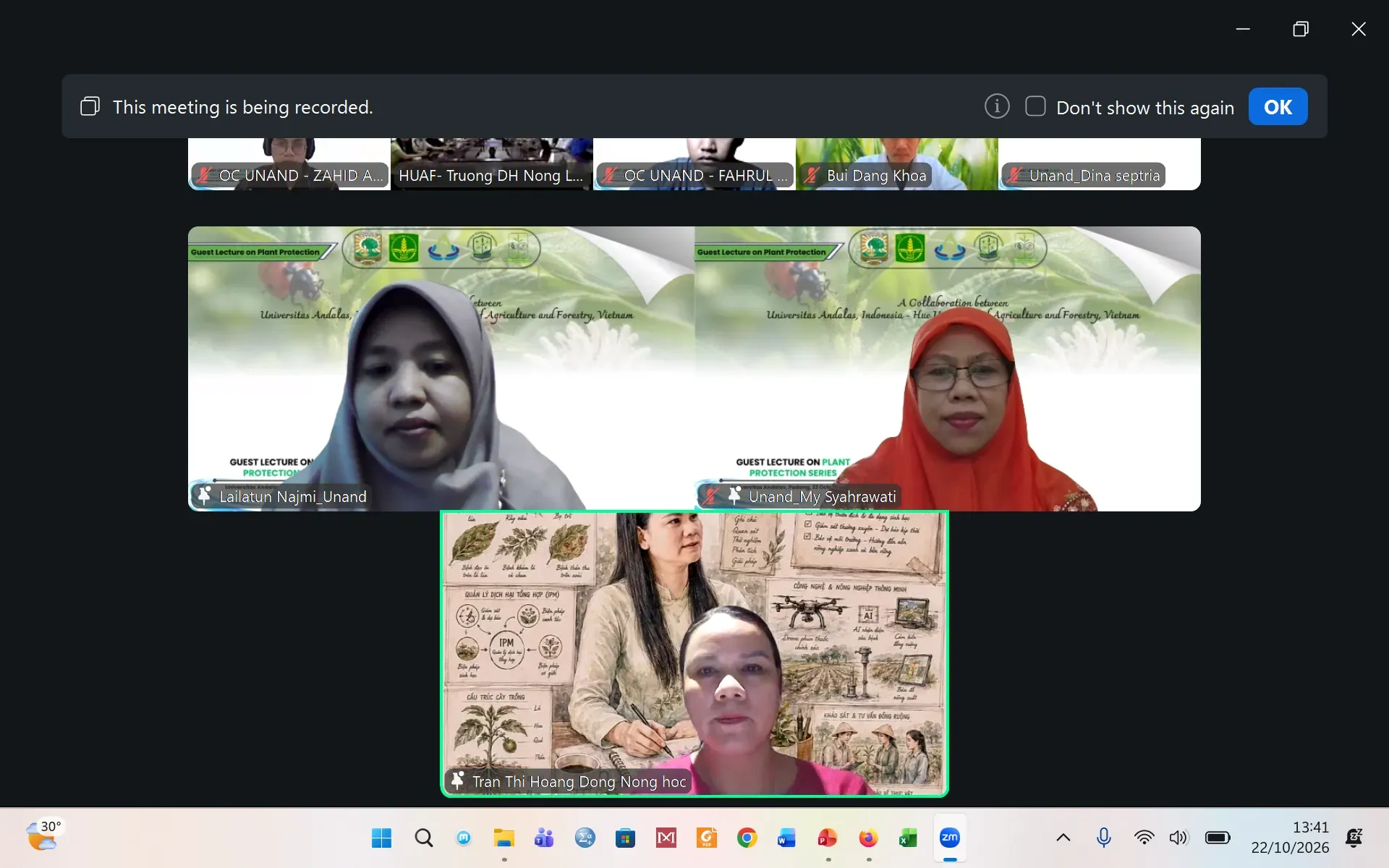
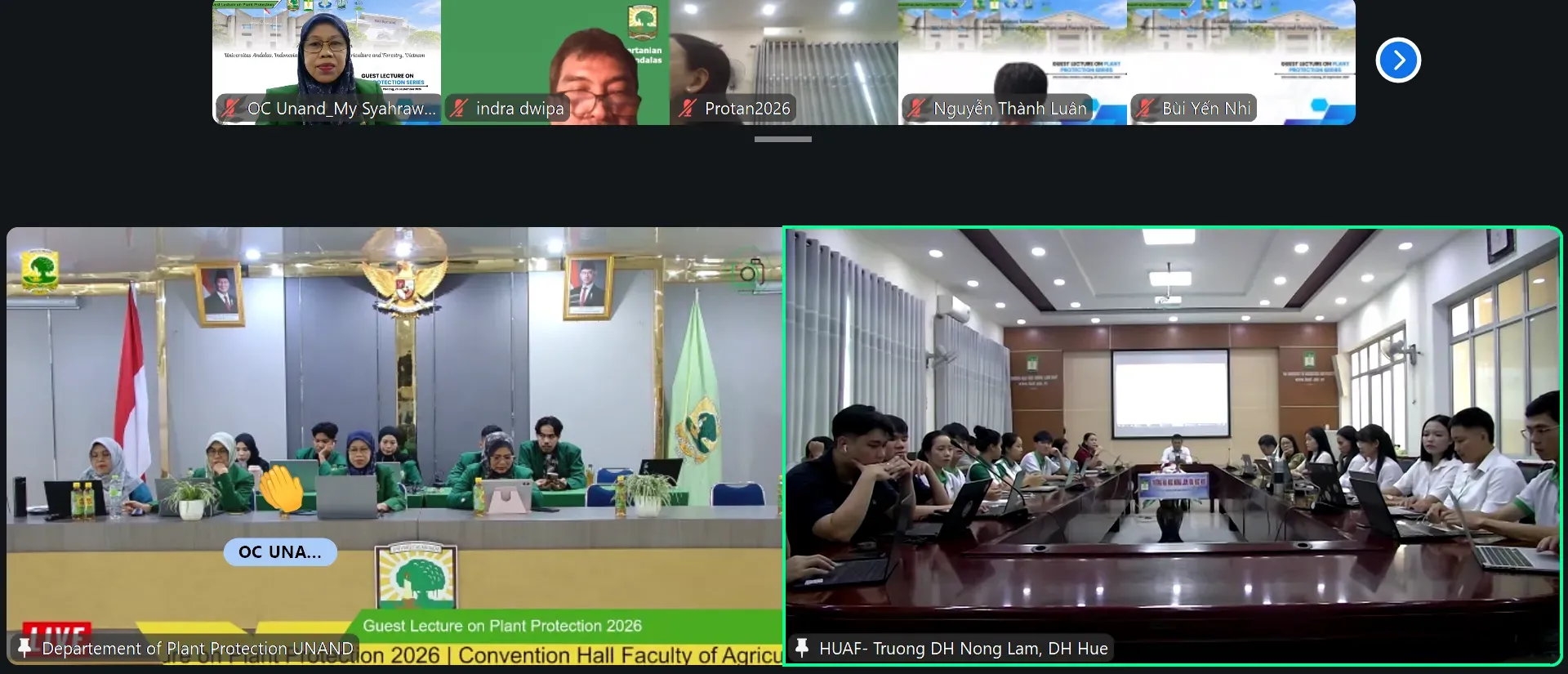
Padang, 22 October 2026 — The Department of Plant Protection, Faculty of Agriculture, Universitas Andalas, held the Guest Lecture on Plant Protection (GLPP) 2026 Session 2 on Thursday, October 22, 2026. Conducted online starting at 1:30 p.m. Western Indonesian Time, the event was intended for faculty members and students of Universitas Andalas (UNAND), Indonesia, and Hue University of Agriculture and Forestry (HUAF), Vietnam. GLPP Session 2 provided a platform for exchanging knowledge and experience in plant protection between the two academic communities.
Focusing on biological pest control, the guest lecture featured two speakers: Dr. My Syahrawati, S.P., M.Si., from Universitas Andalas, and Assoc. Prof. Dr. Tran Thi Hoang Dong from HUAF. The session was moderated by Lailatun Najmi, S.P., M.P., a junior lecturer in the Department of Plant Protection, Universitas Andalas.
In her presentation, “Biocontrol Insect Pests: Approaches and Case Studies in Vietnam,” Assoc. Prof. Dr. Tran Thi Hoang Dong discussed the role of biological control in integrated pest management and shared research findings and practical applications across several agricultural commodities in Vietnam.
The case studies covered the biological control of the coconut leaf beetle, Brontispa longissima; the coconut black-headed caterpillar, Opisina arenosella; the cassava pink mealybug, Phenacoccus manihoti; and the onion leafminer, Liriomyza chinensis. Her presentation addressed the use of parasitoids, the development of natural enemy rearing techniques using alternative hosts, and field release and evaluation.
Dr. My Syahrawati then delivered her presentation, “Making Biocontrol Work: From Theory to Practice.” She explored the use of predators as biological control agents, tracing historical applications and discussing the development of practical field strategies. Her presentation emphasized predator exploration and selection, assessments of predatory capacity and survival, and the implementation of conservation and augmentation approaches.
Drawing on research in rice agroecosystems in West Sumatra, Dr. My Syahrawati highlighted the potential of the predatory beetle Verania lineata and the spider Pardosa pseudoannulata to suppress the brown planthopper, Nilaparvata lugens. She also discussed interactions among predators and the role of flowering plants in providing supplemental food and shelter for natural enemies. The presentation illustrated the importance of understanding predator biology and ecology to support their application in pest management.
Both presentations highlighted that successful biological control requires a sound understanding of target pests, biological control agents, and agroecosystem conditions. Rearing techniques, appropriate release practices, resource availability for natural enemies, and compatibility with crop management practices are essential to effective pest suppression.
Stay tuned for GLPP Session 3 on 21 November 2026!
Let’s Protect Plants Together!